
How to Find Collaborators and Partners for Your Business
08 August 2024

Understanding the Importance of Collaboration
Many entrepreneurs think that their idea is so innovative and impressive that all they need to do is get grant funding and their idea and business will take off. They do not realize that it is not easy to get people to use new technologies – no matter how great their product ends up being. It is very important to get support from potential partners, collaborators, and of course, potential customers. Before you can have a winning proposal, you must recruit the right people with the right knowledge and expertise. These partnerships can help you to win grants.
Challenges in Embracing Collaboration
In the U.S., people have been brought up believing in accomplishing goals for themselves — so the idea of “collaboration” does not come naturally. However, people in industry who have large problems to solve and a limited amount of time to address those problems always use teams to tackle the issue. However, most people have little training on how to be a valuable partner or collaborator. This process requires the stakeholders to have an open mind and be committed to solving a problem in a particular way.
Benefits of Collaboration
Collaboration is important because:
1. The more people with expertise and diverse points of view who are committed to developing a solution – the more likely it will be well-developed and high-quality.
2. The more individuals and organizations that are involved in solving the problem, the more support there will be, and the more likely that the product will actually meet the need.
3. There may be more than one “correct” way of solving the problem and incorporating both ways or working through both processes will produce a better final outcome.
The Iterative Process of Finding Partners
The process of finding partners and collaborators is an iterative process. You most likely will not find the perfect collaboration partner in your first round of replies, but you may get a sense about who is available and how their skill sets may fit your needs. To get your project off of the ground, you usually need a combination of resources, skills, and experience.
Determining the Right Number of Collaborators
You also need to decide how many collaborators you are willing to bring on-board. Many consultants and collaborators may decrease the total workload, but as you have heard in the past “too many cooks spoil the broth.” Therefore, I would just obtain as many collaborators as needed to build a successful project.
Grant Funding Agencies Often Favor Partnerships
Many grant funding agencies prefer or require partnerships. Most federal agencies like for-profit companies to partner with universities so that they can mutually benefit each other. There are also grants that prefer partnering with city agencies or not-for-profit organizations. However, not every partner or collaborator needs to be paid from the grant funds. Collaboration can occur in any manner between companies, individuals, or universities to make the technology or program better by working together in a sensible and methodical manner.
Each partner may receive a different amount of funding or benefit, depending upon how they are going to contribute to the program. A long-term collaborative approach may ensure that as different grant opportunities come along, the other partners will benefit with the full support of who will get funding in this round.
Organizations should be reaching out to other organizations in their field of interest – even if those organizations are competitors. These calls are important to discuss how you can work together in a mutually beneficial manner. These types of relationships can take time, which is why you want to be continuously working on building these types of relationships for your business.
Showing Funder How You Work with a Partner or Collaborator
Many grants that require collaboration have different requirements for verifying the collaborative relationship. Letters of Commitment (Memoranda of Understanding (MOU)) show the grant funders how your company will work with another entity or individual to meet the grant program objectives. If the grant allows these – they should definitely be included. These letters are often “minicontracts” that are attached to the grant appendix or sometimes can be included in the grant body text. A paragraph in the grant body text should describe each collaborative effort.
Mutually Beneficial Partnerships: For a collaboration or partnership to be successful, everyone needs to benefit. This cannot be achieved if any of the parties involved feel abused, misrepresented, or taken advantage of. To obtain collaborators and partners, you need to make it clear that they will benefit by working with you on your idea. If you approach the relationship as a quid pro quo, you will be forced to figure out what you bring to the table in terms of skills and experience. If the partner or collaborator is in academia, the benefit can be (1) funding, (2) consulting fees, (3) publication authorship, or (4) advancing the collaborator’s research interests.
Transparency: When you approach potential collaborators, clearly tell them why you are seeking a collaborator, what you need from them, and in what time frame. This can save you a lot of time in extended but fruitless discussions. Some of the reasons maybe:
1. Lack of resources: The project is too large to do by yourself or you need specialized equipment.
2. Lack of skills: The project requires a complementary set of skills and experience
3. Lack of data: Your collaborator may have access to data that can expand the parameters of your study
Steps to Take to Find Collaborators and Partners
1. Look at your proposed workplan for your project. List all personnel that it would take to accomplish each task.
2. Compare the personnel that you need for each task versus the personnel that you currently have. Create a list of positions that you need.
3. Due to the limited SBIR budgets, think about how certain roles can be filled using a contractor, consultant, partner, or collaborator. If you need a person for less than 50 hours over the Phase I project, I would find a consultant to fill that role. (Just a reminder – the PI has to be an employee of the company and has to spend 51% of their time on the project based upon a standard 40 hour work week).
4. Most federally funded grants like to see for-profit companies teaming up with professors and/or universities. Find part of the work plan that can benefit from have a professor’s expertise to provide guidance, consulting, or feedback. If there is a large gap that needs to be filled on the workplan, teaming up with the university (professor and one or two grad students) may be able to fill that need.
5. Look for team members, collaborators, and partners that have strengths in areas where you do not – or strengths in areas where you are lacking in the team.
6. When reaching out to possible collaborators, partners, or consultants, compile an email introducing yourself and your company. In the email and the attachments, make sure that you demonstrate credibility because you want to convince the collaborator that you can accomplish what you propose. You can establish credibility by showing your industry and/or academic accomplishments or getting introduced by someone who can vouch for you. It may also help to offer to collaborate with them on their ideas.
7. Collaborators, partners, and consultants may offer to help flesh out or edit the part of the proposal that describes how they are going to help with the project.
8. After you have agreed on the work scope for the project, it may be appropriate to discuss their fee or hourly consulting rate.
9. For the grant submission, a Letter of Collaboration, Letter of Commitment, or Letter of Support is needed. The typical practice is to write the letter for them so they can edit and sign it.
About the Author
Colleen Spiegel, Ph.D. is the founder of SEMSCIO, a R&D and STEM entrepreneurial training company that specializes in helping companies obtain non-dilutive funding from federal agencies such as the National Science Foundation (NSF), National Institutes of Health (NIH), Department of Energy (DOE), Department of Education (DOE), NASA, as well as many others. Colleen has worked as an engineer and scientist for several industries in the past such as renewable energy, semiconductors, and pharmaceuticals, and previously had a high-tech startup in fuel cells (Clean Fuel Cell Energy). She has a B.S and M.S. in Chemical Engineering and a Ph.D. in Electrical Engineering from the University of South Florida.
Free ebooks
Looking to enhance your business skills and improve your chances of success? Download our FREE eBooks and gain valuable insights into key aspects of entrepreneurship and grant proposal writing.
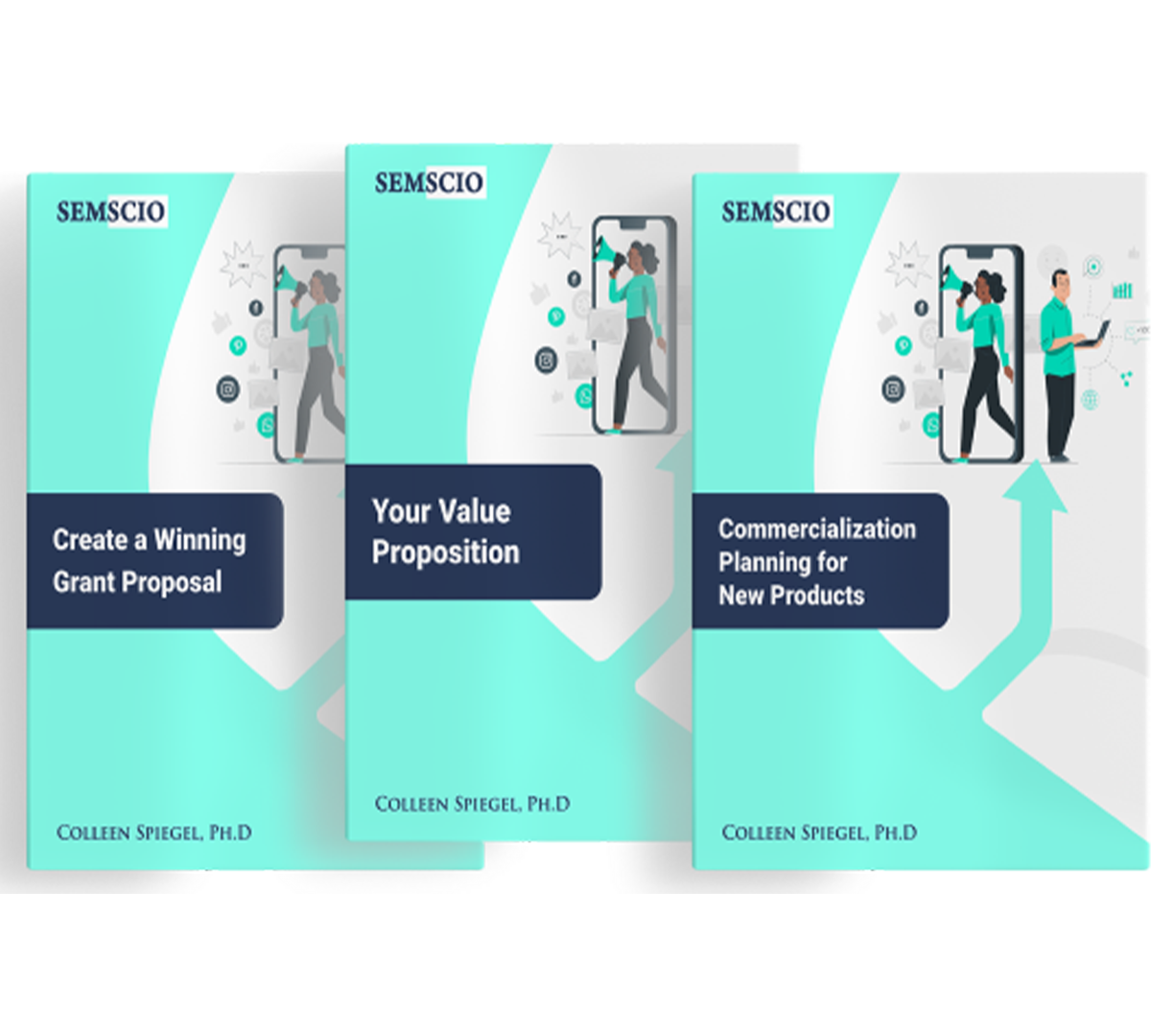
01. Create a Winning Grant Proposal
This Free eBook provides advice to assist you in compiling essential aspects of your grant proposal.
02. Your Value Proposition
Discover how to craft a compelling value proposition that resonates with your target audience and sets your business apart from the competition.
03. Commercialization Planning for New Products
This Free Ebook includes information on effectively conducting market research, performing a preliminary market assessment, and budget and financial considerations
- You can unsubscribe at any time and your information is kept 100% confidential and never sold.
Questions? Let's TaIk.
We’ll help you determine if SEMSCIO is the right fit for you and answer any of your questions.